According to the International Ice Hockey Federation, 27 players were killed, along with two coaches and seven club officials. International Ice Hockey Federation president Rene Fasel called the crash "the darkest day in the history of our sport." Among those confirmed deceased are: Coach Brad McCrimmon, forward Pavol Demitra, defenseman Ruslan Salei, forward Josef Vasicek, defenseman Karel Rachunek, forward Jan Marek, forward Alexander Vasyunov, defenseman Karlis Skrastins and goalie Stefan Liv. "We have no team anymore," Vladimir N. Malkov, Lokomotiv Yaroslavl spokesman, said in a telephone interview with The New York Times. "All our starting players, and all the service people, they all burned in the crash."
Twitter was abuzz with reaction from throughout the NHL community. Fans, players, and writers all chimed in with thoughts and prayers for the victims and their families. Russian and Czech players were the most affected as many had close bonds with those on the plane. When Jonathan Toews of the Chicago Blackhawks heard the news he said, "This is the worst summer ever for hockey." It's hard to disagree.
Today's crash is reminiscent of the crash last April which saw all 96 people on board perish, including Polish President Lech Kaczyński and his wife. A large co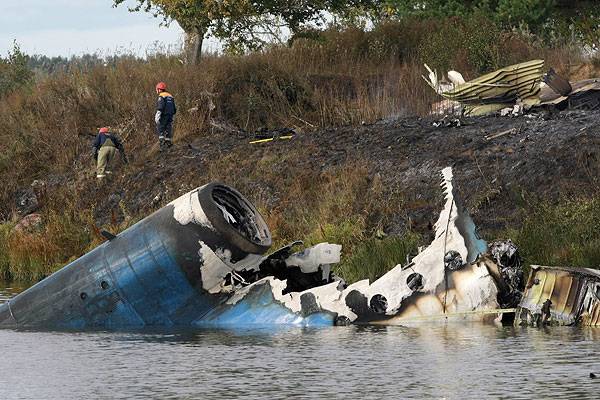 ntingent of the Polish government was on board that plane en route from Warsaw to Smolensk to commemorate the 70th anniversary of the Katyn Massacre. In the days and weeks ahead, more will become known about exactly what happened and why the plane crashed. It's also highly likely there will be some controversy surrounding the investigation, as there was after the investigation of the crash last April. Russia and other former Soviet Republics have a reputation for poor air traffic safety and for flying antiquated aircraft. According to ESPN:
 me under fire in 2008 after the death of 19 year-old Alexei Cherepanov, who collapsed on the bench during a game and eventually died when Russian doctors were unable to save him. The tragic video of the incident shows how poorly prepared the team and arena were to deal with such a medical emergency. According to reports, the ambulance that is normally at all games had already departed and had to be called back; doctors arrived on the scene a full 15 minutes after Cherepanov collapsed, and the battery on the defibrillator used to attempt to shock Cherepanov's heart back to life was drained. It took approximately 20 minutes to get him to a hospital. To date, no criminal charges have been filed relating to the incident, but several doctors and team officials were suspended indefinitely from the KHL.
The KHL and NHL have had a tense and difficult relationship since the formation of the KHL in 2008. With no salary cap and no formal transfer agreement with the NHL, the KHL has often played fast and loose in trying to lure NHL players away from North America with varying degrees of success. Even with the lure of additional millions from the KHL, any player considering a move to Russia should pause to consider the league's spotty safety record.
It is not clear how the KHL will deal with the loss of an entire team as it does not have provisions in place for a tragedy of such massive proportions. One possibility is to have a draft which would restock the club with players from other teams in the KHL. It will surely be a sad and difficult season for the KHL after such a tragedy, but they will find a way to persevere. The hockey world has seen enough tragedy this summer to last for decades. We can only hope that a wonderful and exciting season awaits to brighten our days.
Twitter was abuzz with reaction from throughout the NHL community. Fans, players, and writers all chimed in with thoughts and prayers for the victims and their families. Russian and Czech players were the most affected as many had close bonds with those on the plane. When Jonathan Toews of the Chicago Blackhawks heard the news he said, "This is the worst summer ever for hockey." It's hard to disagree.
Today's crash is reminiscent of the crash last April which saw all 96 people on board perish, including Polish President Lech Kaczyński and his wife. A large co
ntingent of the Polish government was on board that plane en route from Warsaw to Smolensk to commemorate the 70th anniversary of the Katyn Massacre. In the days and weeks ahead, more will become known about exactly what happened and why the plane crashed. It's also highly likely there will be some controversy surrounding the investigation, as there was after the investigation of the crash last April. Russia and other former Soviet Republics have a reputation for poor air traffic safety and for flying antiquated aircraft. According to ESPN:"The cause of Wednesday's crash was not immediately apparent, but Russian news agencies cited unnamed local officials as saying it may have been due to technical problems. The plane was built in 1993 and belonged to a small Moscow-based Yak Service company.
In recent years, Russia and the other former Soviet republics have had some of the world's worst air traffic safety records. Experts blame the poor safety record on the age of the aircraft, weak government controls, poor pilot training and a cost-cutting mentality."
The KHL came under fire in 2008 after the death of 19 year-old Alexei Cherepanov, who collapsed on the bench during a game and eventually died when Russian doctors were unable to save him. The tragic video of the incident shows how poorly prepared the team and arena were to deal with such a medical emergency. According to reports, the ambulance that is normally at all games had already departed and had to be called back; doctors arrived on the scene a full 15 minutes after Cherepanov collapsed, and the battery on the defibrillator used to attempt to shock Cherepanov's heart back to life was drained. It took approximately 20 minutes to get him to a hospital. To date, no criminal charges have been filed relating to the incident, but several doctors and team officials were suspended indefinitely from the KHL.The KHL and NHL have had a tense and difficult relationship since the formation of the KHL in 2008. With no salary cap and no formal transfer agreement with the NHL, the KHL has often played fast and loose in trying to lure NHL players away from North America with varying degrees of success. Even with the lure of additional millions from the KHL, any player considering a move to Russia should pause to consider the league's spotty safety record.
It is not clear how the KHL will deal with the loss of an entire team as it does not have provisions in place for a tragedy of such massive proportions. One possibility is to have a draft which would restock the club with players from other teams in the KHL. It will surely be a sad and difficult season for the KHL after such a tragedy, but they will find a way to persevere. The hockey world has seen enough tragedy this summer to last for decades. We can only hope that a wonderful and exciting season awaits to brighten our days.